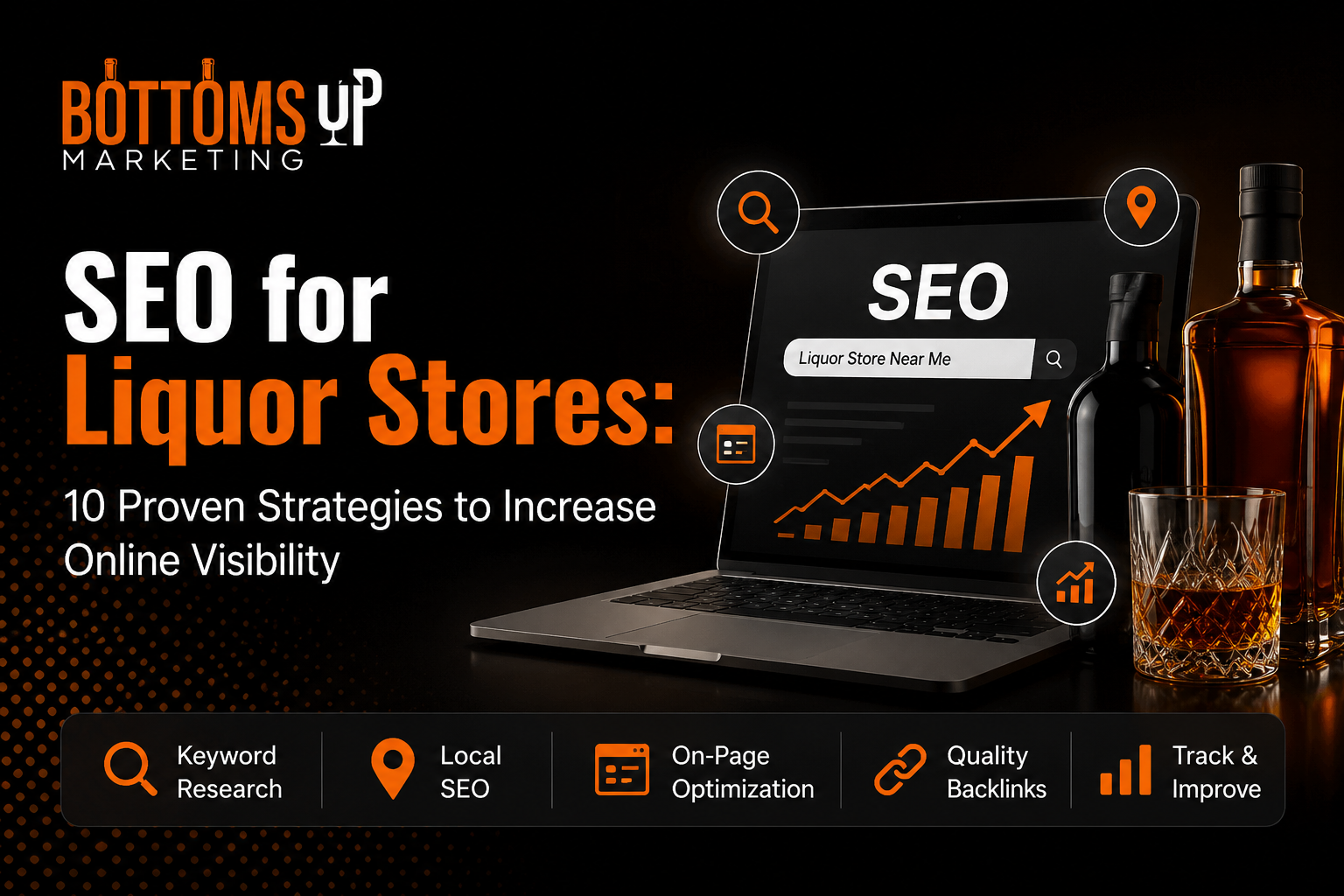
When a customer needs a last-minute bottle for dinner or wants to find the best whiskey selection in town, they search Google first. If your store isn’t showing up, you’re handing that sale to a competitor.
That’s where SEO for liquor stores comes in. It’s one of the most cost-effective tools an independent bottle shop, wine store, or spirits retailer can use to drive consistent foot traffic.
Here are 10 proven alcohol store SEO strategies to successfully turn searches into sales.
Strategy #1: Optimize Your Google Business Profile (GBP)
Your GBP is the foundation of local liquor store online visibility. When someone searches for “liquor store near me,” Google’s local map pack is the first thing they see. If your profile isn’t fully optimized, you won’t appear there, no matter how good your website is.
Step-by-Step Guide to Optimize Your Profile
- Add your complete business name, address, phone number, and hours (including holiday hours)
- Choose the right primary category (e.g., “Liquor Store,” “Wine Shop,” or “Beer Store”)
- Add high-quality photos: inside, outside, shelves, and even staff
- Write a keyword-rich business description that sounds human, not templated
- Actively collect and respond to Google reviews, both positive and negative
Consistency and completeness are of value here. An incomplete profile signals distrust to Google and customers alike.
Strategy #2: Target Local SEO Keywords
Someone typing “best whiskey selection” is usually not doing academic research; they’re trying to decide which store to go to. That subtle urgency changes how you approach alcohol store SEO.
Start with the right keywords. Forget about broad terms like “whiskey” and go for geo-modified, intent-driven phrases such as “craft beer store [neighborhood],” or “spirits delivery [zip code].” These searches signal someone ready to buy.
Use Google Search Console to find what’s already driving traffic to your site, then build more content around those terms. For wine store SEO, varietal-specific keywords like “natural wine shop [city]” or “Pinot Noir near me” convert exceptionally well.
Strategy #3: Create Location-Specific Content
If you operate in multiple neighborhoods or serve multiple cities, a single homepage isn’t enough. Location-specific pages tell Google and your customers exactly where you can be found. This dramatically improves your liquor store online visibility.
Each location page should include your full NAP (name, address, phone), embedded Google Map, unique content about that location, nearby landmarks, parking information, and customer reviews from that area.
Think page ideas such as “[City]’s Guide to Finding Natural Wines” or “Top Spirits Selections in [Neighborhood].” These pages help rank in local search and build trust with community-specific customers.
Strategy #4: Build High-Quality Backlinks
Backlinks are one of the strongest benchmarks for your liquor store Google ranking. Google treats them as votes of confidence. But not all links carry the same value. Credibility matters.
Link Building Strategies for Liquor Stores
- Submit your site to local chambers of commerce and business directories
- Get featured in local food and drink publications
- Sponsor community events or food festivals and earn links from event pages
- Partner with local event organizers or food bloggers for co-created content
Remember, focus on relevance and authority, not volume. Ten links from reputable local news sites, culinary blogs, or regional hospitality associations will outperform 500 links from random directories.
Strategy #5: Optimize Your Website for Mobile
Google now uses the mobile version of your website as the primary basis for ranking. That means if your pages load slowly or navigation breaks on a phone, then your liquor store Google ranking will take a direct hit.
Mobile Optimization Checklist
- Page load time under 3 seconds
- Tap-friendly buttons and navigation
- Clickable phone number prominently displayed
- Easy-to-navigate menu and category structure
A mobile-optimized site isn’t optional; it’s a baseline requirement for competitive alcohol store SEO.
Strategy #6: Create SEO-Friendly Website Content
Your website content has two jobs: keeping Google’s algorithm happy and helping customers make the right purchase. Thin product descriptions and vague category pages won’t cut it. Detailed, helpful, keyword-rich content wins.
High-Performing Content Types
- Buying guides: “How to Choose the Right Whiskey for a Gift”
- Pairing guides: “The Best Wines to Pair with Grilled Meats”
- Product spotlights: Deep-dive pages on specific bottles, producers, or regions
- FAQ pages: Address common customer questions (these often capture voice search traffic)
- Seasonal content: “Top Holiday Gift Sets Under $50” or “Best Summer Cocktail Ingredients”
Each piece is an opportunity to naturally incorporate your target keywords while genuinely serving your audience. Content that helps with conversions ranks higher.
Strategy #7: Leverage Local Citations
A citation is any online mention of your business name, address, and phone number (NAP). Having citations across Yelp, Apple Maps, Bing Places, local directories, and delivery platforms like Drizly signals to Google that your business is legitimate and geographically anchored.
Only one problem here: Google gets confused if your address is listed as “123 Main St” on your website but “123 Main Street, Suite A” on Yelp. Audit your citations twice a year to ensure your NAP is identical across all platforms.
Strategy #8: Implement Schema Markup
Schema markup is code that helps Google understand your website’s content. It can unlock rich snippets that display your hours, ratings, or products directly in search results.
For liquor store SEO, prioritize:
- LocalBusiness schema: Name, address, hours, and contact info
- Product schema: Featured bottles or product categories
- Review/Rating schema: Display your star rating in search results
Use Google’s Structured Data Markup Helper to generate the code, then validate it with the Rich Results Test.
Strategy #9: Develop a Blog Strategy
A consistent blog is one of the most underused assets in alcohol store SEO. Done well, it builds authority, captures long-tail search traffic, and gives customers a reason to return to your website regularly.
Structure your content around three pillars: educational (distillery history, tasting notes, production methods), practical (cocktail recipes, pairing guides, gift ideas), and local (community events, new regional releases, store news).
Aim for two posts per month, each targeting a specific keyword cluster. Topics could include:
- “Best wines under $20”
- “How to pair whiskey with food”
- “Beginner’s guide to craft beer”
Some posts will do well. Others won’t. Consistency matters more than perfection.
Strategy #10: Monitor Performance with SEO Analytics
Set up Google Search Console to track which keywords are driving clicks, which pages are losing rankings, and where opportunities exist. Pair it with Google Analytics 4 to understand on-site behavior: bounce rate, time on page, and conversions.
A monthly 30-minute review of organic traffic trends, ranking changes, and local pack appearances is enough to catch problems early and spot your next growth opportunity.
Common SEO Mistakes Liquor Stores Make
- Ignoring GBP Optimization: An unclaimed or sparse Google Business Profile is the single fastest way to lose local search visibility.
- Targeting Only Broad Keywords: Trying to rank for “whiskey” or “wine” is tough. Local, specific, intent-driven keywords convert far better.
- Inconsistent Business Information: Mismatched NAP details across directories confuse Google and erode your local SEO authority.
- Poor Mobile Experience: A slow or clunky mobile site is a direct ranking penalty.
- Not Collecting Reviews: Reviews influence both local ranking and customer trust.
How Bottoms Up Marketing Can Help
At Bottoms Up Marketing, we specialize in digital marketing for the alcohol industry. We understand the unique compliance requirements, advertising restrictions, and competitive dynamics that set liquor store marketing apart from any other retail business.
Our alcohol store SEO services are purpose-built for liquor stores: from GBP optimization and location-specific content creation to managing citations, implementing schema markup, and tracking performance.
Conclusion
Improving your liquor store online visibility isn’t about one big step. It involves taking a series of smaller, consistent actions to clearly tell both the algorithm and your customers that you’re the best option in your area.
By combining a fully optimized Google Business Profile, targeted local keywords, location-specific content, quality backlinks, and consistent technical SEO, you can build a sustainable stream of organic traffic that keeps working long after you’ve stopped paying for ads.
To achieve results, you need time, consistency, and expertise to execute well.
Ready to Grow Your Liquor Store’s Online Presence?
Bottoms Up Marketing builds SEO strategies tailored to alcohol retailers to improve visibility, attract local customers, and drive sustainable growth. Reach out to us at 516-665-1600 and find out how we can help you grow.
Frequently Asked Questions
1. How long does it take to see SEO results for a liquor store?
Ans. Typically, noticeable improvements take 3-6 months. Some changes, like GBP optimization, can show quicker results within weeks.
2. Can liquor stores use paid advertising alongside SEO?
Ans. Yes. Paid drives immediate traffic; SEO builds lasting authority. The two work best together.
3. What’s the best way to get reviews for a liquor store?
Ans. Ask at the right moment, such as after a positive in-store experience. Keep it simple, perhaps offer a QR code.
4. How often should I update my Google Business Profile?
Ans. At least monthly. More often, if you have promotions, events, or seasonal updates.
5. Is it safe to use SEO for alcohol retail, given advertising restrictions?
Ans. Yes. SEO focuses on organic visibility, which is generally compliant when done correctly.
6. Should we optimize for “near me” searches?
Ans. Absolutely. Those searches often have high intent and lead to immediate visits.
7. What keywords should a wine store focus on vs. a spirits store?
Ans. Wine stores can lean into educational and pairing-based keywords, while spirits stores may benefit more from product-specific and brand-focused searches.
